Earn & Borrow
Yield and borrowing for your customers
Platforms use Base infrastructure and third-party lending markets to offer eligible customers variable stablecoin yield and loans against their digital assets.
Why Offer Earn & Borrow
Financing products that work for your business
Grow and retain assets on your platform
Give customers additional utility for supported balances, and a way to access liquidity without selling.
Scale your business
Earn from eligible stablecoin balances, or from fees on loans against assets your customers already hold.
Differentiate your product offering
Offer yield and borrowing options that set you apart from platforms where customers can only hold or sell.
Supplied Across Base Markets
28D average balances across tracked Base lending protocols, as of October 1, 2026.Lenders
Borrowers
Why Base
Deep, live lending markets on Base

4.45%Average Yield
Average USD stablecoin yield across Base lending markets, prior to any incentives.
Net New Assets
Add rewards on top of lending rates
Some protocols and ecosystem programs offer additional rewards on eligible markets. Talk to our team about programs for your app.
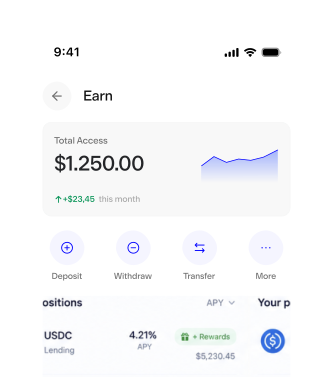
How It Works
Give customers more ways to use their assets
Deposit
A customer deposits supported stablecoins in your app.
Earn
Deposits earn a variable rate from borrowers across lending markets on Base.
Withdraw
Customers can withdraw and stop earning, subject to available liquidity and protocol terms.
The Stack
Base Earn is the stack that powers the product, and the service that helps you build it
- Your App: A customer deposits USDC in your app.
- Wallet: Holds customer assets and signs transactions. Your platform chooses the wallet and custody model. Examples: CDP Wallet, Any wallet.
- Vaults (optional): Borrowers pay interest on overcollateralized loans. That interest is the main source of yield.
- Lending Protocols: Independent curators choose which lending markets a vault supplies to and set its risk limits. Deposits can also go to a protocol directly. Examples: Morpho, Aave.
- Base: The network these apps, wallets and protocols run on. Deposits, loans, repayments and liquidations are recorded onchain.






Your App
A customer deposits USDC in your app.
Your App
A customer deposits USDC in your app.

Names are examples, not endorsements. Base has commercial relationships with Morpho and Aave. Vaults are run by independent curators. Base and Coinbase do not curate, manage or guarantee any vault.
Frequently Asked Questions
Supported stablecoins, such as USDC, supplied to third-party lending markets on Base. Supported assets vary by market.
Depending on your product design, you may keep a share of the yield earned on customer balances you supply to lending markets. You set any yield share, disclose it to your customers, and are responsible for meeting applicable legal and regulatory requirements.
Deposits are supplied to third-party lending protocols on Base, such as Aave and Morpho, either directly or through vaults run by independent curators. Borrowers pay interest on loans from those deposits, and that interest is the main source of yield. Loans are overcollateralized when made, but collateral can lose value, and liquidation may not fully repay a loan.
Rates are variable, change often and are not guaranteed. The Markets page shows the current average USD stablecoin lending rate on Base, updated daily. What customers receive also depends on the platform's yield share and fees.
Base has deep, live lending markets: $3.41B supplied and $2.54B borrowed across 135 markets as of 2026-10-02. Platforms can use existing markets rather than building their own. Live rates and liquidity are on the Markets page.
A curator is an independent team that runs a vault. It chooses which lending markets the vault supplies to and sets its risk limits. Base and Coinbase do not curate, manage or guarantee any vault.
Lending and borrowing through third-party protocols carries risk, including loss of funds. Key risks include: Smart contract risk: Protocols may contain bugs or vulnerabilities. Audits, where available, reduce but do not eliminate this risk. Collateral and liquidation risk: Loans are overcollateralized, and protocols sell collateral if its value falls below a set threshold. In fast markets, or if a price feed fails, liquidation may not fully repay the loan, and lenders may take losses. Curator risk: Independent curators choose which markets a vault lends to and set its risk limits. Their decisions can cause losses. Caps and allocations are visible onchain but can change at any time. Price feed and stablecoin risk: Price data can be wrong or delayed, and stablecoins or wrapped assets can lose their peg.
Yes. Lending through third-party protocols carries risk, including loss of funds from smart contract failures, liquidations that do not fully repay a loan, curator decisions, or a stablecoin losing its peg. See “What are the risks?”
Withdrawals draw on supplied funds that are not currently lent out. If most of a market's funds are borrowed, some withdrawals may be delayed until borrowers repay, new deposits arrive, or loans are liquidated. There is no guaranteed timeframe. When a market is highly used, its borrow and supply rates typically rise, which can encourage repayments and new deposits. This does not guarantee that funds will become available. Vault withdrawals also depend on the markets the vault lends to and on curator allocations. Protocols may pause or restrict withdrawals under their terms, and losses from bad debt may reduce what lenders can withdraw. Platforms are responsible for explaining withdrawal timing and risks to their customers.
Base does not hold or custody customer funds. While deposited, funds sit in third-party lending protocol smart contracts. Who controls the wallet and signs transactions depends on the integrating platform and product design. The platform is responsible for explaining this to its customers.
Timing depends on the integration, wallet and custody model, market and curator review, security testing, customer disclosures, and applicable legal and regulatory requirements. Using an existing supported market may reduce implementation time but does not guarantee launch or availability. We scope timing with you up front.
This page is for informational purposes only. It is not investment, legal, tax, or accounting advice, or an offer, solicitation, or recommendation to buy, sell, hold, lend, borrow, or transact in any asset or pursue any yield or borrowing strategy. Earn and borrowing products involve risks, including variable rates and fees, loss of assets, liquidity and withdrawal limits, collateral price changes and liquidation, and smart contract, oracle, market, and counterparty risks. Rates, yield, funding, availability, supported assets, limits, eligibility, fees, repayment, withdrawals, and collateral release vary by product, protocol, curator, platform, wallet arrangement, and jurisdiction, and are not guaranteed.
Base provides general-purpose blockchain infrastructure and may provide technical or ecosystem support and introductions to third parties. Base does not itself offer or manage Earn products, lend to end users, provide custody through this service, set rates, or guarantee yield, funding, liquidity, withdrawals, collateral recovery, or protection from liquidation. Provider roles depend on the implementation and applicable written terms; integrating platforms make their own product, risk, compliance, custody, and eligibility decisions. References to third parties do not imply endorsement or partnership. Businesses offering these products are responsible for their applicable legal, regulatory, licensing, consumer-protection, disclosure, AML/sanctions, risk, and eligibility requirements. Any support or incentives are subject to availability, eligibility, review, and separate written terms.
Start building on Base.
Build on the open economy. Fast, liquid and always on.